Showing posts with label deflation. Show all posts

Wednesday, October 5, 2011

The Rising Dollar and the Market's Decline.

Last May in The WSJ, I noted that despite commodity inflation, supply-side guru Robert Mundell predicted “a return to recession later this year when QE2 ends and the dollar begins its inevitable rise. Deflation, not inflation, should be the greater concern.”

Mundell has since noted he sees little threat of substantial US inflation because M1 money velocity has collapsed by half and is likely to stay down.


In the Journal article, I wondered how Mundell could be concerned with deflation when commodities including gold and oil were rising sharply, and explained his answer came from the exchange rate between the dollar and the euro, which Mundell calls “the most important price in the world.”

According to Mundell, the financial crisis of 2008 was set off by the dollar's rapid fall versus the euro from summer 2007 to spring 2008, followed that summer by an historic 30% dollar rise within three months, the largest major currency appreciation in peacetime history. (The dollar's rise is represented by the steep decline in the euro:)


The rising dollar caused gold to drop sharply:


Oil plummeted from $140 to below $40:


And the consumer price index plummeted from 5.5% to 0% that December, then to -2% in early 2009:


This rapid dollar appreciation caused liquidity to become tight in the midst of the subprime mortgage solvency crisis, freezing the financial system and causing the near-systemic failure.

Despite radical actions by US monetary authorities in the years since, in Mundell’s view, the gravitational pull on the dollar has been back to its strong position versus the euro.

In winter 2009, the Fed initiated its first quantitative easing program (QE1), which pushed the euro/dollar rate down, easing the liquidity crisis. When it ended in late 2009, the dollar rose sharply again, weakening the recovery. QE2 was initiated in summer 2010 and the dollar declined again, improving prospects for recovery.


Now, QE2 has ended, and there is talk of monetary easing from the ECB. These factors, perhaps combined with Europe’s mounting debt crisis, have pushed the dollar up versus the euro, with the euro falling from $1.45 in late August to $1.31 yesterday, a decline of about 10% in one month:


Confirming the stronger dollar, commodities have sold off impressively in recent weeks. Gold is down about $250 since its September high above $1,900:


While a rising dollar is usually a bullish signal, it may be that the Dow’s recent decline is due to investor memories of the last two dollar surges which coincided with tighter money, debt crisis, and contractionary pressures. Today’s market weakness may be due as much to worry about a soaring dollar as to other factors.

Time will tell, but so far Mundell’s unconventional analysis is holding up. Exchange rates -- the relative value between major currencies -- are as important as the absolute value signaled by gold in any discussion of stable money.

Sunday, May 22, 2011

Mundell: Deflation Risk for the Dollar (WSJ).

The following appeared in The WSJ on May 23, 2011.

Mundell: Deflation Risk for the Dollar
The Nobel winner says a stable dollar-euro rate is the best economic medicine.

By Sean Rushton

Conservative economists have been raising alarms for months about the Federal Reserve's second quantitative-easing program, QE2. They argue it has lowered the dollar's value, leading to higher oil and commodity prices—a precursor to broader, more damaging inflation.

Yet the man many of them regard as their monetary guru—supply-side economics pioneer and Nobel Laureate Robert Mundell—says dollar weakness is not his main concern. Instead, he fears a return to recession later this year when QE2 ends and the dollar begins its inevitable rise. Deflation, not inflation, should be the greater concern. Avoiding the recession is simplicity itself: Just have the U.S. Treasury fix the exchange rate between the dollar and the euro.

Mr. Mundell's surprising statement came at a March 22 conference in New York sponsored by the Manhattan Institute, The Wall Street Journal and the Ronald Reagan Presidential Foundation. His economic predictions carry great weight because, unlike most economists of his generation, he is often right. His analysis of international economics has revolutionized the field, making him the euro's intellectual father and a primary adviser to China's economic policy makers.

Nevertheless, with gold around $1,500 and oil above $100 a barrel, supply-siders are scratching their heads: How can he possibly see deflation ahead? How can dollar weakness not be the problem?

The key to Mr. Mundell's view is that exchange rates transmit inflation or deflation into economies by raising or lowering prices for imported items and commodities. For example, when the dollar declines significantly against the world's second-leading currency, the euro, commodity prices rise. This creates U.S. inflationary pressure. Conversely, when the dollar appreciates significantly against the euro, commodity prices fall, which leads to deflationary pressure.

From 2001-07, he argues, the dollar underwent a long, steady decline against the euro, tacitly encouraged by U.S. monetary authorities. In response to the dollar's decline, investors diverted capital into inflation hedges, notably real estate, leading to the subprime bubble. By mid-2007, the real-estate bubble had burst. In response, the Fed reduced short-term interest rates rapidly, which lowered the dollar further. The subprime crisis was severe, but with looser money, the economy appeared to stabilize in the second quarter of 2008.

Then, in summer 2008, the Fed committed what Mr. Mundell calls one of the worst mistakes in its history: In the middle of the subprime crunch—exacerbated by mark-to-market accounting rules that forced financial companies to cover short-term losses—the central bank paused in lowering the federal funds rate. In response, the dollar soared 30% against the euro in a matter of weeks. Dollar scarcity broke the economy's back, causing a serious economic contraction and crippling financial crisis.

In March 2009, the Fed woke up and enacted QE1, lowering the dollar against the euro, and signs of recovery soon appeared. But in November 2009, QE1 ended and the dollar soared against the euro once again, pushing the U.S. economy back toward recession. Last summer, the Fed initiated QE2, which lowered the value of the dollar, allowing a second leg of the recovery to take hold.

Nevertheless, Mr. Mundell views QE2 as the wrong solution for the problem. Instead, the U.S. and Europe simply should coordinate exchange-rate policies to maintain an upper and lower limit on the euro price, say between $1.30 and $1.40. Over time, the band would be narrowed to a given rate. Further quantitative easing would be off the table.

With a fixed exchange rate, prices could move free from the scourge of sudden deflation and inflation, allowing investment horizons and planning timelines to expand along with production levels on both sides of the Atlantic. To supercharge the U.S. recovery, he also recommends permanently extending the Bush tax rates and lowering the corporate income tax rate to 15% from 35%.

Above all, he made it clear that the volatile exchange rate is the responsibility of the U.S. Treasury, not the central bank. Without a breakthrough on exchange rates, he predicted another dollar appreciation following QE2, resulting in a return to recession and a worsening of the U.S. debt crisis. This would likely lead to a third round of quantitative easing, continuing the dysfunctional cycle.

Criticize the Fed all you like, Mr. Mundell says, but the key to recovery is to stabilize the dollar at a healthy level relative to the euro. Given his stellar track record, it's worth asking: Is anyone in Washington listening?

Mr. Rushton edits The Supply Side blog.

Monday, February 21, 2011

Long weekend round up.

In The Financial Times, Robert Zoellick once again mentions gold as relevant to building a 21st century monetary system.

At New World Economics, Nathan Lewis explains why rate targeting is an unreliable method to manage a currency’s value.

On The Kudlow Report, Larry debates rising prices:


The WSJ notes no one is talking about deflation any more.

On CNBC, Ralph Benko examines state efforts to return to a gold-backed dollar.

At Forbes, David Malpass suggests the budget deficit is crippling the economy.

Cato’s Dan Mitchell argues for eliminating the corporate income tax:


On NRO, Larry Kudlow urges Wisconsin’s governor to stick to his guns.

Dick Morris notes Republican willingness to raise taxes to balance the budget (h/t: Vlad Signorelli).

From the Heritage Foundation, J.D. Foster explains the flaw of demand-side stimulus.

Bloomberg notes China’s efforts to rein in inflation.

At Fortune, Nin-Hai Tseng recounts that while China is growing fast, most Chinese are still poor.

Sunday, December 5, 2010

Weekend round up.

On RCM, John Tamny argues lower housing prices are good for the economy.

Also on RCM, Larry Kudlow advocates pro-growth tactics to improve the employment picture.

From The Heritage Foundation, Steve Forbes makes the moral case for capitalism:


The NY Sun advocates an audit of Federal Reserve bail outs.

In The WSJ, John Fund reports the Americans prefer spending cuts to tax increases by 59% to 30%.

The Huffington Post reports just how grim the unemployment data really is:


At The San Francisco Chronicle, Lisa Smith summarizes the Laffer Curve.

From AEI’s The American, Donald Losman rejects deflation predictions, citing rising gold.

Also in The Journal, Holman Jenkins notes weakening support for the euro among former
supporters.
Even faced with maximal turmoil, Europeans are still trying to have it both ways. The bailout to-ing and fro-ing by European authorities is conditioned largely on their unwillingness to choose between conflicting goals—on one hand, a continent of competitive and open economies; on the other hand, a "social model" that cushions established interest groups and voting blocs from the stress of competition.

A very different approach to managing the current crisis is imaginable. Put the European Central Bank in charge of printing liquidity to prop up the continent's banks. (Right now it's printing liquidity to prop up governments, which are propping up the banks.) Let badly indebted governments go into default and negotiate more manageable terms with their creditors (mostly banks). Let politicians in these countries invest their limited political capital in promoting growth rather than austerity. Let them cut taxes and deregulate their labor markets.

This would certainly sound preferable to voters than job-killing tax hikes and spending cuts to appease far-off German taxpayers who are being dragooned into refinancing their insupportable debts. The most encompassing description of Europe's problem, after all, is the one not mentioned enough: a shortage of growth.

Wednesday, November 3, 2010

Wednesday round up.

In response to yesterday’s large Republican electoral gains, John Tamny argues for sound money as key to political success:
Despite the undeniable good that will result from the Tea Party movement hopefully forcing the political class to show spending discipline wrought by strict constitutional limits, there’s seemingly a big hole in the platform. Specifically, it’s hard to discern any interest in stabilizing the value of the dollar.

This is important, and it’s also a constitutional issue. Indeed, the Constitution empowers Congress “to coin money, regulate the value of”, and this line in the document if properly read says that Congress must legislate the issuance of dollars that hold a specific value today, tomorrow, and ten years from now.

In short, the Tea Parties, to be successful, must demand that the political class get serious about redefining the dollar in terms of gold. If not, all their spending, tax, pro-Constitution and anti-bailout protests won’t mean a whole lot, and the economy’s full recovery will remain a distant object.
At NRO, Larry Kudlow makes a similar point:

The GOP needs a King Dollar policy, preferably one backed by gold. A depreciating dollar will drain cash from the U.S. and send it overseas; foreign investment into the U.S. will be stunted by a chronically weak dollar. And the inflationary consequences of the devaluing dollar will ultimately outweigh any low-tax-rate incentives.

As the dollar kept falling during the Bush years, it blunted the pro-growth effects of the 2003 tax cuts. There is a crucial lesson to be learned here: A strong and stable dollar is an essential complement to low tax rates.

Regarding Team Obama, it now appears that Tim Geithner’s protest that no country can devalue its way into prosperity was a lot of smoke-blowing. His credibility is going to suffer.

On The Kudlow Report, Stephen Moore analyzes the electoral results:


At CNBC, John Carney predicts Treasury Sec. Geithner is a goner.

On Bloomberg, supply-side guru Robert Mundell raises alarm bells that the falling dollar will create deflationary pressures in Europe:

In an earlier speech at a forum run by Bank of America- Merrill Lynch, Mundell, 78, said the Fed’s quantitative easing was “terrorizing” the world economy. In the interview, he drew parallels between a quantitative easing-induced dollar devaluation and the “inflation tax” of the 1970s, where depreciation caused by rising U.S. prices reduced the value of dollar holdings of governments and investors around the world.

“Dollars were depreciating in value, dollars were the major reserve, this was a tax on dollars held outside” the U.S., Mundell said.

On CNBC, David Stockman claims the U.S. Fed has destabilized the world economy and forces emerging markets to buy U.S. bonds:


At Politico, Cato’s David Boaz advocates Republicans focus on the economy, but makes no mention of the dollar.

On CNBC, Professor Mundell answers five questions about himself.

Thursday, October 7, 2010

Thursday items.

On RCM, Charles Kadlec explains that higher tax rates on the rich are equivalent to domestic tariffs on doing business with high-income individuals and small businesses.

The NY Sun editorializes on the history of JFK, Nixon and gold.

On The Kudlow Report, Larry discusses the weak dollar’s impact on the oil price:


In Foreign Policy, Keynesian Barry Eichengreen
analyzes the present currency war.

From 2004, Jude Wanniski and Eichengreen
correspond on currency and gold.

Larry Kudlow
wonders if this week’s Gallup poll led to the market rally.

At WSJ video, Stephen Moore
examines job losses:


At The Journal, Tadashi Nakamae
suggests the U.S. is repeating Japan’s monetary errors.

From 2009, Alan Reynolds
debunks Keynesian analysis of Japan’s deflation.

On CNBC’s Netnet, Ash Bennington
analyzes Art Laffer’s recent WSJ piece.

At Intermex Financial, Ricardo Valuenzuela posts a 2005 Wanniski book review on American entrepreneurship in Jude’s memory.

Sunday, August 29, 2010

Weekend round up.

Don Luskin cites gold's fall in 2008 versus its current high level as proof the economy isn't going to double dip.

Larry Kudlow is bullish on U.S. Rep. John Boehner's (OH) recent economics speech.

Cato's Steve Hanke analyzes a possible rupiah redenomination that would chop three zeroes off the current denomination.


At IBD, Alan Reynolds chronicles the rise of the Consumer Financial Protection Agency.

And on the Cato@Liberty blog, Reynolds challenges the demand-side claim that consumers aren't spending.

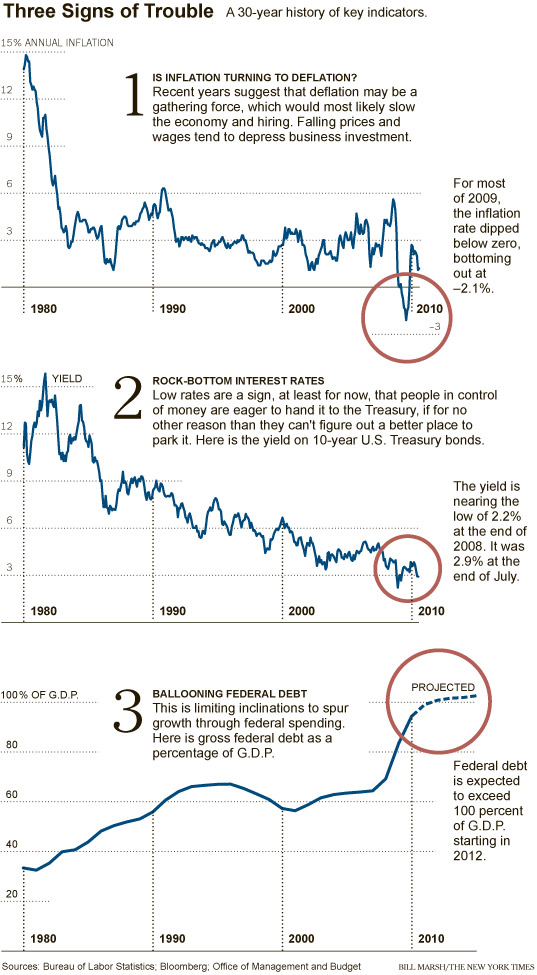
At The NYT, Peter S. Goodman analyzes the economy with some interesting charts (click the chart for clearer version).


At Forbes, Steve Forbes interviews Neuberger Berman's CEO on the bond market.

At The Daily Bell, Forbes predicts a return to gold-based money.

From the upcoming film, "I Want Your Money," Forbes summarizes supply-side economics.

On The Kudlow Report, Peter Schiff debates Fed policy.


At The WSJ, Kelly Evans profiles the professor leading the Austrian economics revival.

AP's Today in History recounts that Jude Wanniski died five years ago today.

Monday, August 16, 2010

Monday update.

Alan Reynolds responds to Paul Krugman's claim that revenue to government was low under Reagan.

John Tamny doesn’t see the U.S. succumbing to a Japanese style deflation.


From winter 2009, here’s a similar item.


In 2001, Jude Wanniski distinguished between falling prices due to contraction versus monetary deflation in which the dollar’s value is rising.


At New World Economics, Nathan Lewis discusses This Time is Different by Reinhart & Rogoff.


Joe Weisenthal at www.businessinsider.com charts CPI's progress since the dissolution of the gold standard:

In The WSJ, Cato's Gerald P. O'Driscoll explains why loose money from the Fed won't help.


While O'Driscoll's piece is good, he falls into the trap of blaming low short term interest rates, rather than the dollar's lower quality as measured against gold, for the recent asset boom.

Sunday, July 18, 2010

Friday update.

Larry Kudlow sees political uncertainty holding back business.

On The Kudlow Report, Sen. Tom Coburn suggests Washington policy is hostile to capital formation, investment and risk taking.

Also on Kudlow, a panel debates deflation vs inflation.

On CNBC, Steve Forbes explains the weak economy.

Jay Ambrose reports on a philanthropist's evolution in Africa from socialist to capitalist.

Paul Krugman recycles the Keynesian critique of Reaganomics, that tax cuts lead to rising interest rates. Here's the record from the 1980s:


From 2004, George Gilder defends Reagan's supply-side policies.
Since 1980, U.S. marginal tax rates fell some 40 percent on income and 75 percent on capital gains and dividends, and the American economy added close to 36 million jobs. During the same time period, Europe and Japan created scarcely any net new employment outside of government. American companies now constitute 57 percent of global market capitalization, and the U.S. commands close to one half of the world’s economic assets.

America, responsible for one fifth of global GDP in 1980, produced one third of global GDP in 2003....

Why then do critics still speak of “voodoo economics”? Why is it that even some supply-siders insistently deny that lower tax rates pay for themselves with higher revenues, when Reagan’s tax cutting regime brought about a fivefold rise in federal spending without increasing the government share of GDP? Why does the current administration still speak of $1.6 trillion tax cuts and $300 billion stimulus packages as if it cost money to reduce perverse and counterproductive government burdens?

One key reason is the stultifying grip of the demand-side model on the entire economics community. University and media economists still find themselves far behind Reagan in grasping the dynamics of an international economy. The economics profession functions like an establishment of flat earth physicists still patiently waiting for the ships of supply-siders to fall off the edge of the world.

While the economics profession remained lost in a maze of equilibrium models, Ronald Reagan knew the facts of entrepreneurial disequilibrium and creativity. To a supply-sider, government is a kind of business. It competes with other governments around the world. It competes to attract entrepreneurs and capital to its jurisdiction and to foster expansion of existing enterprises. By lowering marginal tax rates—the rates on additional activity—governments can induce people to produce and invest within their borders. By raising tax rates, they drive entrepreneurs to other jurisdictions and to non-taxable activities. That is why high tax rates do not redistribute incomes. They redistribute taxpayers out of taxable activities and onto golf courses, into barter exchanges and among foreign regimes with lower rates.

Sunday, July 11, 2010

Friday update.

In The WSJ, Don Luskin worries we may repeat Great Depression-era policies (full article here).


In The Washington Post, Amity Schlaes warns against repeating past economic errors.


From the archives, Austrian economist Friedrich Hayek discusses Keynes' monetary views.


Keynesian C. Fred Bergsten argues global trade imbalances and insufficient U.S. savings are the root of our economic problems. Related charts here.


The IMF advises the U.S. to cut spending and raise taxes.


Alan Greenspan sees a pause in the economic recovery.


Liberal political strategist Bob Shrum frames the debate between liberal stimulus and conservative austerity.


Paul Krugman hopes the Federal Reserve will do more to stimulate the economy.


The Calgary Herald cites Robert Mundell's advice to cut the U.S. corporation tax.


At AEI, floating currency proponent John H. Makin forecasts deflation coming.


Tuesday, June 29, 2010

Tuesday items.

Bloomberg columnist Amity Schlaes suggests George Soros's advice to Germany will weaken the euro.


At National Review, Raymond J. Keating is enthusiastic about supply-sider David Malpass's candidacy.


On The Kudlow Report, Steve Forbes points out that deficits from tax rate cuts are positive while deficits from higher spending are negative.

From the archives, President Kennedy argues for tax rate cuts to increase growth and balance the budget.

Austrian economist Peter Schiff believes spending cuts stimulate supply, which is key to recovery.


At Barrons, Randall W. Forsyth argues low interest rates point to deflation.

Goodbye Supply Side author Kevin D. Williamson calls on Republicans to itemize the spending they will cut.


Friday, June 25, 2010

Friday items.

Larry Kudlow considers the Tea Party's influence.

Cato's Dan Mitchell expresses disappointment in Britain's tax increase.

At National Affairs, R. Gregory Mankiw examines the Obama Administration's response to the recession.

From 1995, the Freeman offers a summary of supply-side economics.

Humorist Merle Hazzard sings about inflation vs. deflation.

Barry Ritholz suggests supply-siders aren't good economic forecasters.

Youtube features a tribute to the late Jack Kemp, in which he says:
Every generation faces choices: hope or despair; to plan for scarcity or to embrace the possibilities. Societies throughout history believed they had reached the frontiers of human accomplishment. But in every age, those who trusted that divine spark of imagination discovered that vastly greater horizons still lay ahead.

Paul Krugman wants the yuan to appreciate faster.

Gary Andres analyzes the gusher of U.S. debt.

Heritage's Brian Riedl argues spending not tax cuts are to blame for the deficit.

Thursday, May 20, 2010

Thursday round up.

John Tamny says there is no deflation.


Dan Mitchell points out that EU nations, on average, impose their top tax rates at much lower income levels than the U.S.


Steve Hanke recently discussed the euro on CNBC.


Forbes summarizes adjustment mechanisms under Robert Mundell’s “Theory of Optimum Currency Areas.”


From the archive, here’s Mundell’s 1961 article, on which the euro is based.


A Cato study says the U.S. corporate tax rate on new investment is the highest in the OECD.


U.S. Rep. Paul Ryan (WI) critiques the financial regulatory reform bill.