NRO’s editors critique Mitt Romney’s support for minimum wage increases.
The WSJ analyzes Rick Santorum’s surge and Romney’s policy vulnerability.
At NRO, Thomas Sowell notes continued conservative opposition to Romney.
In The WSJ, Karl Rove argues Newt Gingrich’s southern strategy is insufficient.
On The WSJ, Larry Sabato discusses Romney’s problems with the right, and general election prospects:
At Forbes, Louis Woodhill highlights wasteful alternative energy spending.
On Forbes, Cato’s James Dorn advocates a sound money policy rather than stimulus.
In The WSJ, Eswar Prasad suggests yuan convertibility is key to its future.
From Bloomberg, Amity Shlaes rebuts Clint Eastwood’s Super Bowl ad.
On The Kudlow Report, a panel discusses the CPAC conference:
At Killer Frogs, Kyle Clifton highlights a Jude Wanniski memo to US Rep. Ron Paul (TX).
From Human Events, House Speaker John Boehner (OH) outlines his growth agenda, including energy exploration, roads and bridges projects, no earmarks, and reduced federal mandates.
Showing posts with label Boehner. Show all posts
Showing posts with label Boehner. Show all posts
Thursday, February 9, 2012


Thursday, November 17, 2011
Thursday items: Woodhill proposes Greek reforms; Domitrovic on 19th century panics; Laffer on Italy.
From Forbes, Louis Woodhill offers Greece a compelling alternative to austerity.
At Forbes, Brian Domitrovic analyzes the economic panics during the classical gold standard.
On The Kudlow Report, Art Laffer sounds optimistic about Italy’s new leader:
From Alhambra Investments, John Chapman explains the US is far more guilty of currency manipulation than China.
In Canada's Financial Post, Peter Foster reports from a Keynesian debate on the parallels between Japan’s deflationary recession and the current US situation. Unmentioned is the yen’s sharp appreciation versus gold and the dollar since the mid-1980s, and the dollar’s sharp appreciation versus the euro and gold in summer 2008.
At NRO, Larry Kudlow highlights positive economic news.
Caffeinated Thoughts notes the gold standard’s popularity with Iowa Republicans.
In The WSJ, Walter Russell Mead sees France and Germany in a struggle over the eurozone’s economic culture:
The WSJ pans the GOP balanced budget plan:
In The WSJ, Jason Riley notes Sen. Marco Rubio’s (FL) pro-immigration rhetoric.
At Forbes, Brian Domitrovic analyzes the economic panics during the classical gold standard.
On The Kudlow Report, Art Laffer sounds optimistic about Italy’s new leader:
From Alhambra Investments, John Chapman explains the US is far more guilty of currency manipulation than China.
In Canada's Financial Post, Peter Foster reports from a Keynesian debate on the parallels between Japan’s deflationary recession and the current US situation. Unmentioned is the yen’s sharp appreciation versus gold and the dollar since the mid-1980s, and the dollar’s sharp appreciation versus the euro and gold in summer 2008.
At NRO, Larry Kudlow highlights positive economic news.
Caffeinated Thoughts notes the gold standard’s popularity with Iowa Republicans.
In The WSJ, Walter Russell Mead sees France and Germany in a struggle over the eurozone’s economic culture:
France is basically a Club Med country with some northern features (historically often found among the Huguenots and Jews, out of which communities many of its most successful business leaders have come). It wants a "political" economic system for Europe, one in which political pressures can ensure the kind of steady devaluation of the euro that Italy, Spain, France, Greece and Portugal used to enjoy with their national currencies in the good old pre-euro days. The only problem with this old system was that it gave too many advantages to the Germans, Dutch and others (in the form of lower interest rates). France wants to stick the Germans with a Latin currency and Latin rules for running it.At RCM, Alan Viard and Chad Hill propose an interesting tax reform idea.
Germany, on the other hand, wants the Latin countries to live by northern rules: Keep the currency sound, the budgets balanced and let the chips fall where they may. There is zero, repeat, zero consensus in Germany to go Latin and give the euro into the hands of slick French and Italian politicians. Technocrats bound by rules, the Germans can accept: That is why an Italian technocrat is following a Frenchman at the head of the ECB. But that is also why the Germans are being such sticklers about ECB rules against bailouts and unlimited ECB purchases of sovereign bonds.
The WSJ pans the GOP balanced budget plan:
Instead, House Speaker John Boehner plans to offer a vanilla amendment that merely calls for a balanced budget, with no spending limitation or supermajority tax requirements. The Speaker seems to believe, or at least hope, that this might attract enough Democratic votes to pass the amendment (which requires a two-thirds vote in both houses of Congress, plus approval in 38 state legislatures).On Bloomberg, James Grant predicts the European Central Bank will continue to loosen (h/t: TGSN):
In The WSJ, Jason Riley notes Sen. Marco Rubio’s (FL) pro-immigration rhetoric.
Thursday, November 3, 2011
Thursday round up: Tamny on China; Woodhill on Keynes; Moore on tax reform.
From RCM, John Tamny defends China on manufacturing jobs.
At Forbes, Louis Woodhill argues against Keynesian stimulus and for a series of interesting reforms.
In The WSJ, Michael Boskin applauds the GOP tax reform contest.
On The Kudlow Report, Stephen Moore discusses tax reform efforts:
At NRO, Larry Kudlow notes the ECB’s surprise quarter-point cut of its target rate.
In The WSJ, Paul Gigot reports Colorado’s rejection of tax increases to pay for education.
On Seeking Alpha, John Bowman notes the Chairman of the Council of Economic Advisors to the French Prime Minister advocates keeping the euro and supply-side solutions.
The Tax Policy Center analyzes the distribution of Gov. Perry’s flat tax plan.
The Economic Policy Institute honors Paul Krugman:
The Washington Post reports House Speaker John Boehner (OH) dismissing anti-tax advocate Grover Norquist.
Also in The Washington Post, Charles Lane rebuts claims that US infrastructure is crumbling.
At Forbes, Louis Woodhill argues against Keynesian stimulus and for a series of interesting reforms.
In The WSJ, Michael Boskin applauds the GOP tax reform contest.
On The Kudlow Report, Stephen Moore discusses tax reform efforts:
At NRO, Larry Kudlow notes the ECB’s surprise quarter-point cut of its target rate.
In The WSJ, Paul Gigot reports Colorado’s rejection of tax increases to pay for education.
On Seeking Alpha, John Bowman notes the Chairman of the Council of Economic Advisors to the French Prime Minister advocates keeping the euro and supply-side solutions.
The Tax Policy Center analyzes the distribution of Gov. Perry’s flat tax plan.
The Economic Policy Institute honors Paul Krugman:
The Washington Post reports House Speaker John Boehner (OH) dismissing anti-tax advocate Grover Norquist.
Also in The Washington Post, Charles Lane rebuts claims that US infrastructure is crumbling.
Thursday, October 20, 2011
Thursday update: Domitrovic on Reagan's unfinished business; Ron Paul says the Fed caused the financial crisis; Forbes, Pethokoukis on Perry's flat tax.
From Forbes, Brian Domitrovic explains that monetary reform is President Reagan’s crucial unfinished business.
In The WSJ, US Rep Ron Paul (TX) blames the Federal Reserve for the financial crisis.
The WSJ reports Rick Perry’s flat tax garners support from Steve Forbes.
The Washington Post forecasts the coming tax battle between Perry and Romney.
On The Kudlow Report, Jimmy P debates Perry’s flat tax proposal:
From NRO, Larry Kudlow notes somewhat improved economic data from last month.
At Forbes, Jerry Bowyer critiques Herman Cain’s 9-9-9 plan.
Dick Morris supports the 9-9-9 plan.
IBD rebuts Paul Krugman and Jared Bernstein’s Keynesian advocacy.
On NRO, Michael Barone suggests bipartisan support to allow more visas for a high-skilled immigrants.
At International Liberty, Dan Mitchell notes a recent video likening President Obama to President Carter:
The liberal Think Progress proves that there’s no point in trying to appease tax hikers with targeted middle class tax cuts.
Factcheck.org disputes the President’s jobs numbers (h/t: Speaker Boehner’s office).
Future of Capitalism notes a new book that praises Michael Milken.
In The WSJ, US Rep Ron Paul (TX) blames the Federal Reserve for the financial crisis.
The WSJ reports Rick Perry’s flat tax garners support from Steve Forbes.
The Washington Post forecasts the coming tax battle between Perry and Romney.
On The Kudlow Report, Jimmy P debates Perry’s flat tax proposal:
From NRO, Larry Kudlow notes somewhat improved economic data from last month.
At Forbes, Jerry Bowyer critiques Herman Cain’s 9-9-9 plan.
Dick Morris supports the 9-9-9 plan.
IBD rebuts Paul Krugman and Jared Bernstein’s Keynesian advocacy.
On NRO, Michael Barone suggests bipartisan support to allow more visas for a high-skilled immigrants.
At International Liberty, Dan Mitchell notes a recent video likening President Obama to President Carter:
The liberal Think Progress proves that there’s no point in trying to appease tax hikers with targeted middle class tax cuts.
Factcheck.org disputes the President’s jobs numbers (h/t: Speaker Boehner’s office).
Future of Capitalism notes a new book that praises Michael Milken.
Tuesday, October 11, 2011
Tuesday update: More on the new economics laureates; Benko on the Heritage monetary conference; Moore on how to raise emplyment.
The WSJ editorial board and David Henderson applaud the new Nobel Laureates (and here).
From Forbes, Ralph Benko links the Occupy Wall Street protestors to last week’s Heritage Foundation conference on a stable dollar.
The NY Sun advises the Republican candidates on key themes for tonight’s debate.
At NRO, Larry Kudlow suggests Monday’s big stock market rally was due to a European bank bailout program taking shape.
On The Kudlow Report, Stephen Moore debates jobs:
At RCM, John Tamny rebuts the President’s claims on green energy subsidies.
On Forbes, Charles Kadlec suggests higher tax rates on the wealthy will do little but spread the misery.
From The Weekly Standard, Larry Lindsey argues cash flow problems are stymieing the economy and the Great Depression was improved by FDR’s decision to devalue the dollar.
At RCM, McCain economist Doug Holtz-Eakin advocates tax reform rather than tariffs to better compete with China.
From last week, The WSJ praises House Speaker John Boehner (OH) for refusing to pass China tariff legislation.
On Kudlow, a panel discusses the Republican primary:
In The Washington Times, Richard Rahn explains the futility of punishing banks for responding to regulatory restrictions.
From The Washington Post, Hernand de Soto notes that “over the past 15 years… as they package, bundle and resell securities, Americans and Europeans have gradually undermined the reliability of the records that guarantee or make credit trustworthy.”
On COAL, Paul Krugman expresses concern that some Occupy Wall Streeters have taken up sound money, but helpfully rebuts opposition to fractional reserve banking.
From Forbes, Ralph Benko links the Occupy Wall Street protestors to last week’s Heritage Foundation conference on a stable dollar.
The NY Sun advises the Republican candidates on key themes for tonight’s debate.
At NRO, Larry Kudlow suggests Monday’s big stock market rally was due to a European bank bailout program taking shape.
On The Kudlow Report, Stephen Moore debates jobs:
At RCM, John Tamny rebuts the President’s claims on green energy subsidies.
On Forbes, Charles Kadlec suggests higher tax rates on the wealthy will do little but spread the misery.
From The Weekly Standard, Larry Lindsey argues cash flow problems are stymieing the economy and the Great Depression was improved by FDR’s decision to devalue the dollar.
At RCM, McCain economist Doug Holtz-Eakin advocates tax reform rather than tariffs to better compete with China.
From last week, The WSJ praises House Speaker John Boehner (OH) for refusing to pass China tariff legislation.
On Kudlow, a panel discusses the Republican primary:
In The Washington Times, Richard Rahn explains the futility of punishing banks for responding to regulatory restrictions.
From The Washington Post, Hernand de Soto notes that “over the past 15 years… as they package, bundle and resell securities, Americans and Europeans have gradually undermined the reliability of the records that guarantee or make credit trustworthy.”
On COAL, Paul Krugman expresses concern that some Occupy Wall Streeters have taken up sound money, but helpfully rebuts opposition to fractional reserve banking.
Tuesday, July 26, 2011
Tuesday roundup: Domitrovic critiques economic historians; Tamny notes Lehman's impact on policy; Forbes lashes California for an internet sales tax proposal.
From Forbes, Econoclasts author Brian Domitrovic echoes Thomas Sowell’s recent criticism of prominent historians for their coverage of tax cuts.
On RCM, John Tamny notes that mistaken fear of a Lehman Brothers-style financial contagion has infected economic policy.
At Forbes, Steve Forbes lashes California for attempting to impose an internet sales tax.
On The Kudlow Report, David Goldman analyzes the debt debate and the economy:
On Reuters, James Pethokoukis gives two cheers to Speaker Boehner’s (OH) debt ceiling plan.
From Asia Times, David Goldman suggests US debt will be downgraded but isn’t worried by it.
IB Times reports the increased interest in gold and gold-linked currency.
At Alhambra Investments, Joe Calhoun remains doubtful about the economy.
On RCM, John Tamny notes that mistaken fear of a Lehman Brothers-style financial contagion has infected economic policy.
At Forbes, Steve Forbes lashes California for attempting to impose an internet sales tax.
On The Kudlow Report, David Goldman analyzes the debt debate and the economy:
On Reuters, James Pethokoukis gives two cheers to Speaker Boehner’s (OH) debt ceiling plan.
From Asia Times, David Goldman suggests US debt will be downgraded but isn’t worried by it.
IB Times reports the increased interest in gold and gold-linked currency.
At Alhambra Investments, Joe Calhoun remains doubtful about the economy.
Wednesday, July 13, 2011
Monday items: Grant on deficits and gold; Schlaes on growth; The WSJ on tax increases.
From Sunday’s Washington Post, James Grant argues a gold standard will restrain US trade and budget deficits.
At Bloomberg, Amity Schlaes suggests increasing economic growth will enable budget cuts.
The WSJ notes the President’s tax increase proposal comes on top of previous tax increases.
On The Kudlow Report, Don Luskin discusses Italy's economy:
At Forbes, John Tamny reviews Reckless Endangerment.
On Washington’s WMAL, Stephen Moore discusses the debt ceiling.
From World Magazine, Christian conservative Alex Tokarev supports the gold standard (h/t: Ralph Benko).
On The Laura Ingraham radio show, Speaker Boehner (OH) confirms his opposition to tax increases.
At Bloomberg, Amity Schlaes suggests increasing economic growth will enable budget cuts.
The WSJ notes the President’s tax increase proposal comes on top of previous tax increases.
On The Kudlow Report, Don Luskin discusses Italy's economy:
At Forbes, John Tamny reviews Reckless Endangerment.
On Washington’s WMAL, Stephen Moore discusses the debt ceiling.
From World Magazine, Christian conservative Alex Tokarev supports the gold standard (h/t: Ralph Benko).
On The Laura Ingraham radio show, Speaker Boehner (OH) confirms his opposition to tax increases.
Wednesday, May 18, 2011
Wednesday round up: Gingrich stresses tax cuts; Wesbury is optimistic; Luskin on the market.
Newt.org reports Gingrich pushing for tax cuts to boost the economy.
In The WSJ, Peter Schuck and John Tyler explain the need for high-skilled immigrants.
At RCM, Brian Wesbury expresses optimistim about the economy.
On The Kudlow Report, Don Luskin discusses the market:
At CNBC, Larry Kudlow suggests a deficit reduction deal is possible.
From Asia Times, David Goldman analyzes the housing market.
On Financial Sense, Alan Reynolds discusses the progressivity of U.S. income tax rates.
From KOA Radio in Denver, CO, Reynolds analyzes the debt debate and growth.
Speaker Boehner’s press office trumpets conservative Keynesian John Taylor tying the debt limit to spending cuts.
In an error-ridden Salon article, Steve Kornacki blames deficits on supply-side economics.
In The WSJ, Peter Schuck and John Tyler explain the need for high-skilled immigrants.
At RCM, Brian Wesbury expresses optimistim about the economy.
On The Kudlow Report, Don Luskin discusses the market:
At CNBC, Larry Kudlow suggests a deficit reduction deal is possible.
From Asia Times, David Goldman analyzes the housing market.
On Financial Sense, Alan Reynolds discusses the progressivity of U.S. income tax rates.
From KOA Radio in Denver, CO, Reynolds analyzes the debt debate and growth.
Speaker Boehner’s press office trumpets conservative Keynesian John Taylor tying the debt limit to spending cuts.
In an error-ridden Salon article, Steve Kornacki blames deficits on supply-side economics.
Tuesday, May 10, 2011
Tuesday summary: Domitrovic on Mexico buying gold; Kudlow on Boehner's speech; Goldman on China.
From Forbes, Brian Domitrovic remembers the Soviet Union’s pursuit of gold to keep itself going.
At TGSN, Domitrovic notes that Mexico is buying gold to get away from the weak dollar.
On NRO, Larry Kudlow applauds Speaker Boehner’s tough debt ceiling speech.
The Financial Times reports Speaker Boehner linked the falling dollar to high commodities in his speech (h/t/: Bretton Woods Research):
On The Kudlow Report, David Goldman discusses U.S. negotiations with China:
At Human Events, John Hayward explains that a weak dollar means strong oil.
On New World Economics, Nathan Lewis measures commodity values against gold.
From Alhambra Investments, Joe Calhoun assesses last week’s dollar spike/commodity dip.
In The NYT, Mark Weisbrot recommends Greece withdraw from the euro and devalue its new currency.
From the Laffer Center archive, Art Laffer argues for a return to dollar convertability.
At NRO, Burt Fulsom suggests spending cuts caused the economic expansions of the 1920s and ‘40s, while spending increases caused the 1970s stagflation.
At TGSN, Domitrovic notes that Mexico is buying gold to get away from the weak dollar.
On NRO, Larry Kudlow applauds Speaker Boehner’s tough debt ceiling speech.
The Financial Times reports Speaker Boehner linked the falling dollar to high commodities in his speech (h/t/: Bretton Woods Research):
In his speech, Mr Boehner took an implicit swipe at the Federal Reserve, blaming it and the Obama administration for high petrol prices. “There’s a clear connection between high gas prices and the weak dollar that some in Washington have quietly welcomed over the past couple of years. It’s well known that when you print tons of money, the dollar sinks, and the price of food and energy rises significantly.”
On The Kudlow Report, David Goldman discusses U.S. negotiations with China:
At Human Events, John Hayward explains that a weak dollar means strong oil.
On New World Economics, Nathan Lewis measures commodity values against gold.
From Alhambra Investments, Joe Calhoun assesses last week’s dollar spike/commodity dip.
In The NYT, Mark Weisbrot recommends Greece withdraw from the euro and devalue its new currency.
From the Laffer Center archive, Art Laffer argues for a return to dollar convertability.
At NRO, Burt Fulsom suggests spending cuts caused the economic expansions of the 1920s and ‘40s, while spending increases caused the 1970s stagflation.
Monday, May 9, 2011
Monday round up: Woodhill on Keynesianism; Rapoza on the yuan; Moore on Speaker Boehner's debt limit speech.
From Forbes, John Tamny explains that policies for energy independence are counterproductive.
On RCM, Louis Woodhill argues Keynesian spending doesn’t stimulate economic growth while supply-side tax cuts do.
In The NYT, Greg Mankiw ponders the economy, inflation and the debt.
At Forbes, Ken Rapoza quotes Bretton Woods Research’s Vlad Signorelli discussing the yuan.
On The Kudlow Report, Stephen Moore applauds House Speaker John Boehner for refusing to raise the debt ceiling without deep spending cuts:
At The Street, Peter Morici argues poor U.S. economic management is driving the world back to gold as money (h/t: Ralph Benko).
The WSJ notes tax receipts have risen substantially.
At The WSJ, Stephen Moore reports on Treasury Secretary Geithner’s measures to keep government paying its bills without a debt ceiling increase.
On Kudlow, James Pethokoukis debates the President’s criticism of CEO pay:
On Lew Rockwell, David Stockman advocates return to the gold standard.
In The Financial Times, John Dizard suggests gold is money but is otherwise useless.
At COAL, Paul Krugman cites Mundell’s Impossible Trinity in arguing for emerging market currencies to appreciate.
Also on COAL, Krugman argues inflation isn’t a problem because wages are flat or falling.
On RCM, Louis Woodhill argues Keynesian spending doesn’t stimulate economic growth while supply-side tax cuts do.
In The NYT, Greg Mankiw ponders the economy, inflation and the debt.
At Forbes, Ken Rapoza quotes Bretton Woods Research’s Vlad Signorelli discussing the yuan.
On The Kudlow Report, Stephen Moore applauds House Speaker John Boehner for refusing to raise the debt ceiling without deep spending cuts:
At The Street, Peter Morici argues poor U.S. economic management is driving the world back to gold as money (h/t: Ralph Benko).
The WSJ notes tax receipts have risen substantially.
At The WSJ, Stephen Moore reports on Treasury Secretary Geithner’s measures to keep government paying its bills without a debt ceiling increase.
On Kudlow, James Pethokoukis debates the President’s criticism of CEO pay:
On Lew Rockwell, David Stockman advocates return to the gold standard.
In The Financial Times, John Dizard suggests gold is money but is otherwise useless.
At COAL, Paul Krugman cites Mundell’s Impossible Trinity in arguing for emerging market currencies to appreciate.
Also on COAL, Krugman argues inflation isn’t a problem because wages are flat or falling.
Tuesday, April 12, 2011
Tuesday round up: Mundell opposes ECB's rate hike; Forbes critiques Merkel's policies; Kadlec counsels monetary reform as debt reform.
Bloomberg reports Robert Mundell opposes the ECB’s interest rate hike.
From Forbes, Steve Forbes critiques German Chancellor Merkel’s handling of the European debt crisis and counsels linking the euro to gold.
Also at Forbes, Charles Kadlec advises Speaker Boehner that without monetary reform it will be impossible to get the budget under control.
On The Kudlow Report, Gov. Mitt Romney (MA) talks about growth and jobs but is unimpressive on the dollar, rejects a flat tax, advocates a floating yuan, and emphasizes raising consumer spending:
From Forbes, Brian Domitrovic corrects Jonathan Chait’s repeated claim that George H.W. Bush called supply-side economics voodoo.
In The NYT, Speaker Boehner warns the President not to try to raise taxes.
At The WSJ, James Taranto notes the flaw in trying to balance the budget by taxing the rich.
On NRO, Larry Kudlow sees market turbulence ahead as the debt ceiling is debated.
Cato’s Dan Mitchell reports the IRS is enforcing foreign tax law:
In The Washington Times, Richard Rahn critiques the IRS code.
On Forbes, Ralph Benko suggests George Soros should focus on bottom up monetary reform.
From Alhambra Investments, Joe Calhoun foresees economic difficulty when QE2 ends.
In The WSJ, Charles Wolf Jr. takes an interesting look at economic, military and population statistics.
From Forbes, Steve Forbes critiques German Chancellor Merkel’s handling of the European debt crisis and counsels linking the euro to gold.
Also at Forbes, Charles Kadlec advises Speaker Boehner that without monetary reform it will be impossible to get the budget under control.
On The Kudlow Report, Gov. Mitt Romney (MA) talks about growth and jobs but is unimpressive on the dollar, rejects a flat tax, advocates a floating yuan, and emphasizes raising consumer spending:
From Forbes, Brian Domitrovic corrects Jonathan Chait’s repeated claim that George H.W. Bush called supply-side economics voodoo.
In The NYT, Speaker Boehner warns the President not to try to raise taxes.
At The WSJ, James Taranto notes the flaw in trying to balance the budget by taxing the rich.
On NRO, Larry Kudlow sees market turbulence ahead as the debt ceiling is debated.
Cato’s Dan Mitchell reports the IRS is enforcing foreign tax law:
In The Washington Times, Richard Rahn critiques the IRS code.
On Forbes, Ralph Benko suggests George Soros should focus on bottom up monetary reform.
From Alhambra Investments, Joe Calhoun foresees economic difficulty when QE2 ends.
In The WSJ, Charles Wolf Jr. takes an interesting look at economic, military and population statistics.
Sunday, April 3, 2011
Weekend update: Lewis on money supply; Kudlow on Obama's re-election; Rep. Ryan says his budget cuts will open GOPers to attack.
From Forbes, Nathan Lewis explains that the correct money supply is that which keeps the dollar’s value steady.
At CNBC, Larry Kudlow suggests stronger job growth is tied to Republican efforts to keep taxes down.
On Fox News Sunday, U.S. Rep. Paul Ryan (WI) acknowledges his forthcoming budget will give Democrats an easy political target:
At Forbes, John Tamny recalls that Nixon’s decision to float the dollar is more relevant to Detroit’s economic decline than liberal governance.
In the Weekly Republican Address, House Speaker John Boehner (OH) argues government spending cuts will lead to lower unemployment.
At The SF Chronicle, Robert Reich critiques Republican economic claims.
From C-Span, Steve Forbes advises Republicans to focus on healthcare rather than general discretionary budget cuts:
At The Financial Times, Joseph Stiglitz advocates increased use of SDRs in place of the dollar standard.
The WSJ reports Utah’s adoption of gold as legal tender.
At CNBC, Larry Kudlow suggests stronger job growth is tied to Republican efforts to keep taxes down.
On Fox News Sunday, U.S. Rep. Paul Ryan (WI) acknowledges his forthcoming budget will give Democrats an easy political target:
At Forbes, John Tamny recalls that Nixon’s decision to float the dollar is more relevant to Detroit’s economic decline than liberal governance.
In the Weekly Republican Address, House Speaker John Boehner (OH) argues government spending cuts will lead to lower unemployment.
At The SF Chronicle, Robert Reich critiques Republican economic claims.
From C-Span, Steve Forbes advises Republicans to focus on healthcare rather than general discretionary budget cuts:
At The Financial Times, Joseph Stiglitz advocates increased use of SDRs in place of the dollar standard.
The WSJ reports Utah’s adoption of gold as legal tender.
Thursday, November 4, 2010
Thursday round up.
At The Washington Post, Fed Chairman Bernanke justifies yesterday’s decision to add $600 billion to the economy.
The NY Sun editorializes that the dollar’s value will predict the fate of the Boehner Republicans.
On The WSJ, Dan Henninger argues Republicans should focus on economic growth over spending cuts:
At Asia Times, David Goldman outlines why quantitative easing won’t work.
On NRO, Larry Kudlow suggests stopping bad ideas may be the best outcome of the Republican House.
The WSJ editorializes against quantatative easing:
On The Kudlow Report, Brian Wesbury sees the Fed funds rate as too low and likely to lead to inflation:
At Forbes, Steve Forbes suggests provisions to change in Obamacare.
From the Mises Institute, Austrian Robert Murphy challenges "60 Minutes" on taxes.
Australia’s you.com discusses the effect of tax rates on the Rolling Stones (H/T: Greg Mankiw):
The NY Sun editorializes that the dollar’s value will predict the fate of the Boehner Republicans.
On The WSJ, Dan Henninger argues Republicans should focus on economic growth over spending cuts:
At Asia Times, David Goldman outlines why quantitative easing won’t work.
On NRO, Larry Kudlow suggests stopping bad ideas may be the best outcome of the Republican House.
The WSJ editorializes against quantatative easing:
The Fed first tried QE, as it's called, with $1.75 trillion of bond purchases starting in December 2008, but that was at the height of the financial panic when markets were frozen. The Fed's justification for this current round is that inflation is too low and growth too slow to reduce unemployment. The Fed promised to buy $600 billion in bonds for starters, and to keep buying until the rate of inflation rises, presumably above its 2% target.In The Financial Times, U.S. Rep. Paul Ryan (WI) emphasizes growth – including sound money.
This is a terribly risky strategy for what we expect will be little economic gain. The Fed hopes the policy will have the effect of reducing long-term interest rates by 25 to 50 basis points or more, but the 10-year Treasury bond is already near historic lows. Marginal business borrowers aren't worried about the price of money; they're worried about the vagaries of economic policy. QE2 only adds to this uncertainty, as the Fed expands its role into fiscal policy and credit allocation.
Meanwhile, Mr. Bernanke's monetary cowbell will flow into higher commodity prices and other assets, perhaps leading to more bubbles. It has already caused havoc around the world, as investors flee the dollar for other currencies. Dollar-bloc countries are already seeing an increase in their price levels and several are contemplating capital controls.
On The Kudlow Report, Brian Wesbury sees the Fed funds rate as too low and likely to lead to inflation:
At Forbes, Steve Forbes suggests provisions to change in Obamacare.
From the Mises Institute, Austrian Robert Murphy challenges "60 Minutes" on taxes.
Australia’s you.com discusses the effect of tax rates on the Rolling Stones (H/T: Greg Mankiw):
The Stones are famously tax-averse. I broach the subject with Keith in Camp X-Ray, as he calls his backstage lair. There is incense in the air and Ronnie Wood drifts in and out--it is, in other words, a perfect venue for such a discussion. "The whole business thing is predicated a lot on the tax laws," says Keith, Marlboro in one hand, vodka and juice in the other. "It's why we rehearse in Canada and not in the U.S. A lot of our astute moves have been basically keeping up with tax laws, where to go, where not to put it. Whether to sit on it or not. We left England because we'd be paying 98 cents on the dollar. We left, and they lost out. No taxes at all. I don't want to screw anybody out of anything, least of all the governments that I work with. We put 30% in holding until we sort it out." No wonder Keith chooses to live not in London, or even New York City, but in Weston, Conn.
Of course, it wasn't just the taxman's pinch that forced the Rolling Stones to focus on the bottom line. They also got screwed by record labels. "In the early days you got paid absolutely nothing," recalls Jagger. "The only people who earned money were the Beatles because they sold so many records."
Sunday, October 10, 2010
Friday round up.
At The NYT, currency manipulation guru C. Fred Bergsten accuses China of protectionism for maintaining a stable currency. Amazingly, Bergsten’s role in the 1970s Great Inflation continues to go unreported.
While at The Financial Times, currency speculator George Soros expresses frustration at China’s stable exchange rate.
On The Kudlow Report, U.S. Rep. Brad Sherman (D-CA) opposes Adam Smith’s view of trade deficits (and here):
The House GOP leader says the election is all about jobs.
In his syndicated column, Charles Krauthammer suggests rising government debt leads to the weak dollar and slow economy, rather than the other way around.
At The Center for Freedom and Prosperity, Dan Mitchell covers the Organization for Economic Cooperation and Development’s opposition to tax competition.
On Forbes, Brian Wesbury and Robert Stein defend capitalism.
While at The Financial Times, currency speculator George Soros expresses frustration at China’s stable exchange rate.
On The Kudlow Report, U.S. Rep. Brad Sherman (D-CA) opposes Adam Smith’s view of trade deficits (and here):
The House GOP leader says the election is all about jobs.
In his syndicated column, Charles Krauthammer suggests rising government debt leads to the weak dollar and slow economy, rather than the other way around.
For the first time since modern budgeting was introduced with the Budget Act of 1974, the House failed to even write a budget. This in a year of extraordinary deficits, rising uncertainty and jittery financial markets. Gold is going through the roof. Confidence in the dollar and the American economy is falling — largely because of massive overhanging debt. Yet no budget emerged from Congress to give guidance, let alone reassurance, about future U.S. revenues and spending.On Fox News, Newt Gingrich indicts the President’s economic policies, saying the choice is between paychecks or food stamps:
At The Center for Freedom and Prosperity, Dan Mitchell covers the Organization for Economic Cooperation and Development’s opposition to tax competition.
On Forbes, Brian Wesbury and Robert Stein defend capitalism.
Wednesday, September 15, 2010
Wednesday articles.
At Opinion Journal, James Taranto discusses the GOP House Leader's mixed message on tax increases for the wealthy.
On CNBC's excellent new NetNet blog (hosted by high school pal John Carney), LoriAnn LaRocco interviews Steve Forbes.
At The New American, Alex Newman offers a comprehensive overview of the rising consensus for a world currency, quoting Robert Mundell. Although Newman clearly opposes such a move, it is inevitable if the dollar continues to be unstable.
Saturday, September 11, 2010
Wednesday round up.
Richard Rahn critiques the President's economic philosophy.
At the Kudow Report, Stephen Moore debates corporate tax reform.
The Washington Times reports that President Obama wants to raise taxes and the House Republican leader wants to cut spending.
At Asia Times, Alexander Casella reports on China's view of its economy.
On NRO, Jim Powell argues government creates the largest financial bubbles.
Also on Kudlow, Dick Armey debates a flat tax.
Sunday, August 29, 2010
Weekend round up.
Don Luskin cites gold's fall in 2008 versus its current high level as proof the economy isn't going to double dip.
Cato's Steve Hanke analyzes a possible rupiah redenomination that would chop three zeroes off the current denomination.

And on the Cato@Liberty blog, Reynolds challenges the demand-side claim that consumers aren't spending.
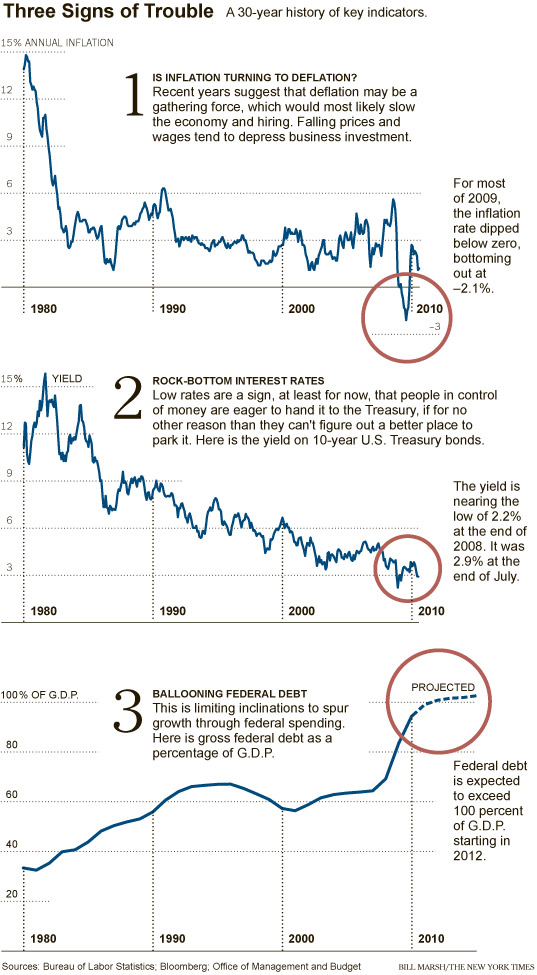
At The NYT, Peter S. Goodman analyzes the economy with some interesting charts (click the chart for clearer version).
At The Daily Bell, Forbes predicts a return to gold-based money.
From the upcoming film, "I Want Your Money," Forbes summarizes supply-side economics.
AP's Today in History recounts that Jude Wanniski died five years ago today.
Subscribe to:
Posts (Atom)