From Forbes, Brian Domitrovic provides the history behind Newt Gingrich’s Gold Commission.
The WSJ uses Mitt Romney’s tax return to argue for fundamental tax reform.
On NRO, Larry Kudlow reports Romney believes the President’s class warfare strategy is designed with him (Romney) in mind.
From Forbes, Steve Forbes advises Mitt Romney to come out with a strong pro-growth, pro-capitalism message.
On The Kudlow Report, Romney critiques Gingrich’s flat tax plan and suggests, oddly, that Congress could manipulate the dollar’s exchange rate under the gold standard:
At The American, James Pethokoukis responds to the President on tax fairness.
From PJ Media, David Goldman argues the true unemployment rate, about 1 in 4, guarantees a single term for President Obama.
At RCM, John Tamny suggests hedge fund success implies stock market weakness.
On Peter Schiff’s radio show, Steve Forbes critiques Romney on the China currency debate:
IBD explains Dodd-Frank’s highly negative effect on small and community banks.
CNSNews notes commodity price increases under President Obama.
At Barron’s, Pimco’s Bill Gross suggests the economy is pulled between deflationary and inflationary forces:
From The Hoover Institution, Richard Epstein critiques Massachusetts Senate candidate Elizabeth Warren’s economic proposals.
The NYT highlights the President’s tough talk on China.
Showing posts with label Schiff. Show all posts
Showing posts with label Schiff. Show all posts
Wednesday, January 25, 2012


Sunday, January 2, 2011
Weekend items.
At New World Economics, Nathan Lewis examines money supply under a gold standard.
On IBD, Alan Reynolds challenges Peter Schiff’s claim that falling real estate prices threaten the economy.
At Fox News, The Journal Editorial Report names U.S. Rep. Paul Ryan (WI) as a winner for 2010, and John Maynard Keynes as a loser:
In The NYT, Harvard’s Greg Mankiw sounds supply-side themes in advising the President on how to understand conservative thinking.
At the liberal Firedoglake, Jest names Jude Wanniski and Art Laffer the worst economists in the world.
On Fox News, Steve Forbes predicts 2011 will bring a dollar crisis:
At Red State, Soleynm suggests President Obama is moving towards supply-side economics.
On Fiscal Times, Bruce Bartlett makes the case for federal budget reform.
On IBD, Alan Reynolds challenges Peter Schiff’s claim that falling real estate prices threaten the economy.
At Fox News, The Journal Editorial Report names U.S. Rep. Paul Ryan (WI) as a winner for 2010, and John Maynard Keynes as a loser:
In The NYT, Harvard’s Greg Mankiw sounds supply-side themes in advising the President on how to understand conservative thinking.
At the liberal Firedoglake, Jest names Jude Wanniski and Art Laffer the worst economists in the world.
On Fox News, Steve Forbes predicts 2011 will bring a dollar crisis:
At Red State, Soleynm suggests President Obama is moving towards supply-side economics.
On Fiscal Times, Bruce Bartlett makes the case for federal budget reform.
Monday, September 27, 2010
Weekend round up.
At New World Economics, Nathan Lewis explains the yen has declined against gold in recent months but remains strong relative to the more rapidly falling dollar.

The LA Times’ Tom Petruno suggests Congress’s stance on China, plus Federal Reserve policy, is driving the dollar down.
On The Kudlow Report, Peter Schiff debates rising gold:
In a poll by Macleans magazine, Robert Mundell loses to Blackberry creator Mike Lazaridis as Canada’s greatest innovator.
At Zero Hedge, Tyler Durden analyzes the national debt.
Also on Kudlow, Stephen Moore discusses the coming election:

The LA Times’ Tom Petruno suggests Congress’s stance on China, plus Federal Reserve policy, is driving the dollar down.
On The Kudlow Report, Peter Schiff debates rising gold:
In a poll by Macleans magazine, Robert Mundell loses to Blackberry creator Mike Lazaridis as Canada’s greatest innovator.
At Zero Hedge, Tyler Durden analyzes the national debt.
Also on Kudlow, Stephen Moore discusses the coming election:
Sunday, August 29, 2010
Weekend round up.
Don Luskin cites gold's fall in 2008 versus its current high level as proof the economy isn't going to double dip.
Cato's Steve Hanke analyzes a possible rupiah redenomination that would chop three zeroes off the current denomination.

And on the Cato@Liberty blog, Reynolds challenges the demand-side claim that consumers aren't spending.
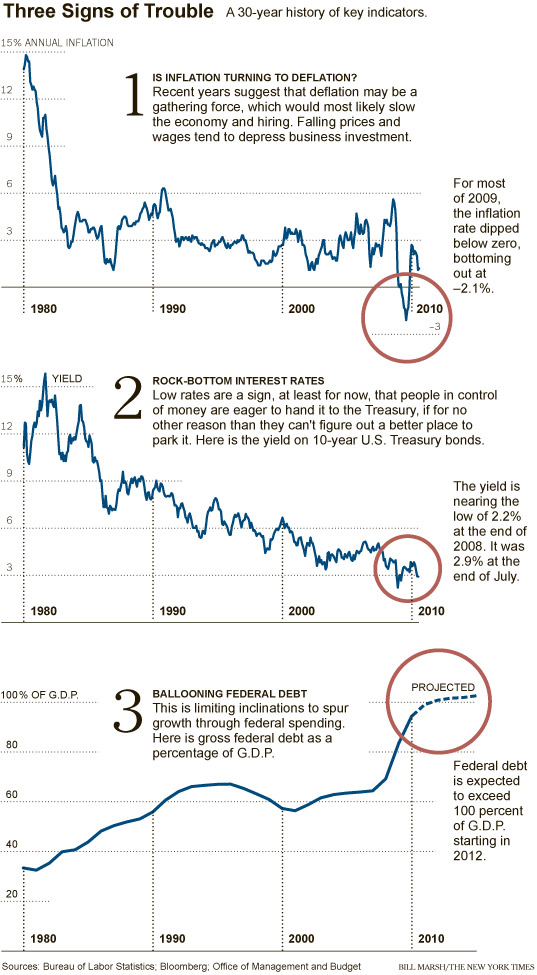
At The NYT, Peter S. Goodman analyzes the economy with some interesting charts (click the chart for clearer version).
At The Daily Bell, Forbes predicts a return to gold-based money.
From the upcoming film, "I Want Your Money," Forbes summarizes supply-side economics.
AP's Today in History recounts that Jude Wanniski died five years ago today.
Tuesday, June 29, 2010
Tuesday items.
Bloomberg columnist Amity Schlaes suggests George Soros's advice to Germany will weaken the euro.
At National Review, Raymond J. Keating is enthusiastic about supply-sider David Malpass's candidacy.
On The Kudlow Report, Steve Forbes points out that deficits from tax rate cuts are positive while deficits from higher spending are negative.
From the archives, President Kennedy argues for tax rate cuts to increase growth and balance the budget.
Austrian economist Peter Schiff believes spending cuts stimulate supply, which is key to recovery.
At Barrons, Randall W. Forsyth argues low interest rates point to deflation.
Goodbye Supply Side author Kevin D. Williamson calls on Republicans to itemize the spending they will cut.
Thursday, June 24, 2010
Thursday round up.
John Tamny argues the dollar is inflationary not deflationary.
The Business Roundtable cites the high corporate tax rate at the top of its list of growth inhibitors.
The WSJ's Steve Moore discusses the report on Kudlow.
The Cato Institute's Dan Mitchell criticizes the Business Roundtable for having supported the stimulus.
WSJ editorialists consider coming tax increases.
As Congress debates derivative regulation, here’s a Joseph Calhoun item from April that explains that dollar volatility is the main reason for derivatives.
David Goldman confirms his thesis on central banks buying gold.
Don Luskin recommends buying bonds.
Austrian economics advocate Peter Schiff wants a gold standard.
Robert Higgs of the Independent Institute suggests lower government spending would improve the economy.
Shawn Tully of Fortune quotes monetarist Allan Meltzer's view that spending cuts led to the British boom under Margaret Thatcher.
Dan Mitchell laments England's tax increases.
From 1999, Lew Rockwell provides an interesting overview of Robert Mundell’s economic contributions.
Subscribe to:
Posts (Atom)